Why your endocrinologist sends diabetic patients to the eye doctor.
Diabetic retinopathy is the #1 cause of vision loss in working-age adults — and almost always silent in its earliest stages. Annual exams catch the leaks years before any patient notices.
Dr. Amy Krempecki, O.D.
·May 9, 2026·5 min read
"My endocrinologist wants me to see an eye doctor. I see fine." We hear this every week, and it is the patient who sees fine that we are most worried about. Diabetic retinopathy is the leading cause of vision loss in working-age adults in the United States, and the cruel part is that you do not feel it coming.
The reason your endocrinologist (or your PCP) checks the box for "annual eye exam" on your diabetes flowsheet is not paperwork. It is one of the single most important early-detection tools we have for the long-term complications of diabetes. Here is what it actually is, what we are looking at, and how the report gets back to your physician.
What diabetes does to your retina
High blood sugar damages the smallest blood vessels in your body. The retina is one of the most exposed places for that damage, because it is densely packed with microvessels that have to stay perfectly intact to feed the rods and cones. Over years, those tiny vessels weaken, leak fluid and blood, and in the worst cases stop delivering oxygen to whole sections of the retina.
The disease progresses through stages we can see directly on a dilated exam or wide-field retinal image:
No retinopathy. The goal. Healthy vessels, healthy retina.
Mild nonproliferative retinopathy. A few microaneurysms — tiny outpouchings in the vessel walls. The patient feels nothing.
Moderate to severe nonproliferative. More microaneurysms, dot-and-blot hemorrhages, cotton-wool spots (areas where small vessels have closed off). Still mostly silent.
Proliferative diabetic retinopathy. The retina, starved of oxygen, grows fragile new vessels. These vessels bleed easily, scar, and can pull the retina away from the back of the eye. This is the stage where vision loss happens.
Diabetic macular edema. At any stage — fluid leaks into the central macula, blurring central vision. The leading cause of legal blindness in diabetics.
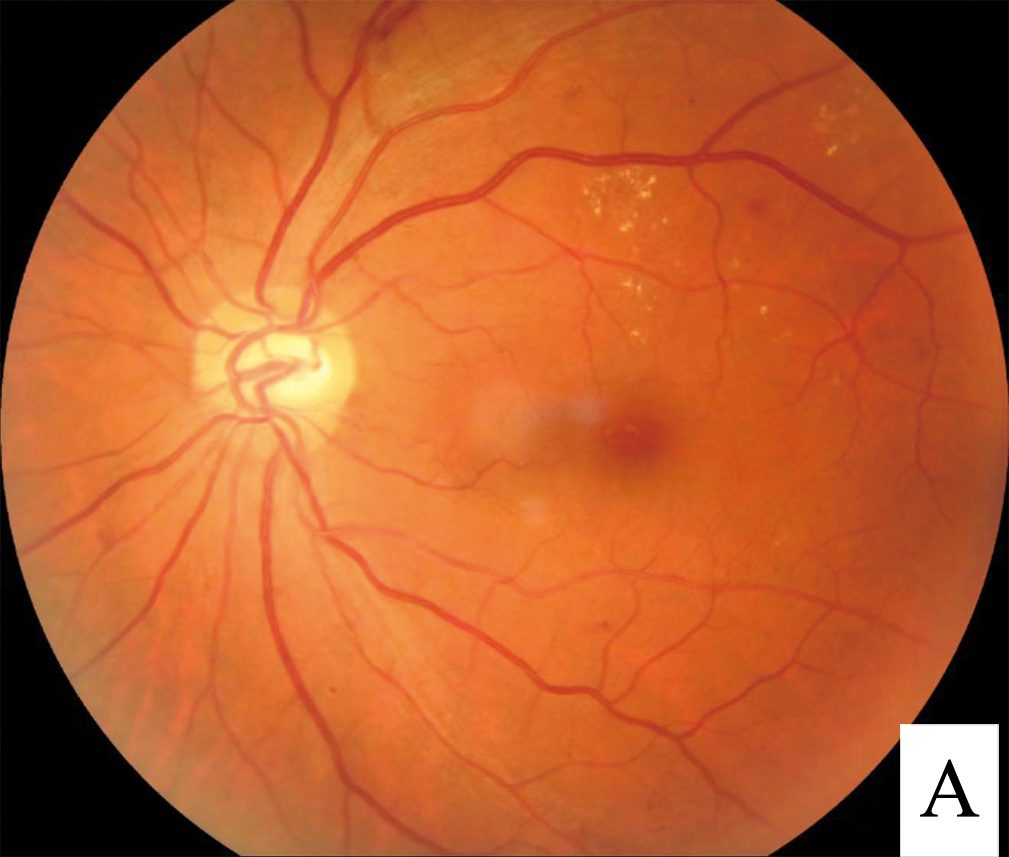
A retinal image of diabetic retinopathy with macular edema. The dark spots are hemorrhages; the lighter yellow patches are leaked lipid (hard exudates).
The thing to know about all of this: none of the early stages cause symptoms. Patients walk in seeing 20/20 with retinopathy already visible on imaging. That is exactly why annual exams matter.
What the exam looks like
A diabetic eye exam at HFEC is a comprehensive exam with extra attention to the retina. Specifically, we will:
Take wide-field retinal photographs (Optomap®) — a single image captures roughly 200 degrees of the back of the eye, including the peripheral areas where retinopathy often starts. Through an undilated pupil for screening.
Recommend a dilated exam when the photos show anything that needs a stereo view, when symptoms have changed, or when it has been more than a year since your last dilation.
Use OCT (optical coherence tomography) to take cross-section scans of the macula, looking for the fluid that defines diabetic macular edema.
Compare today's images to last year's. Stability is what we want. New lesions are what trigger follow-up or referral.
How findings get back to your endocrinologist
This part matters. With your permission, we send a written report to your endocrinologist or PCP after every diabetic exam. The report includes:
Your current visual acuity and refractive status
The stage of retinopathy in each eye, if any
Whether there is macular edema
Comparison to your prior exam if we have one on file
Our recommendation for follow-up timing (annual, six months, three months, urgent referral)
Any recommendation for retinologist referral if treatment is needed
For most of our diabetic patients, that report goes to Western Carolina Internal Medicine, Mountain Diabetes, or one of the larger Asheville endocrinology groups. We do this routinely. Just tell us at check-in who should get the report.
A1C and blood pressure are the strongest predictors of how retinopathy progresses — eye care and primary care are doing the same job from different angles.
What you can do between exams
The retina is downstream of how your diabetes is being managed. The single best thing for your eyes is the same thing your endocrinologist is already telling you about A1C, blood pressure, and lipids. Specifically:
A1C in your target range. Tighter glycemic control slows progression of retinopathy significantly.
Don't smoke. Smoking compounds vascular damage on every front.
Tell us right away about new floaters, a curtain in your vision, sudden blurry vision, or distortion. These can mark a vitreous hemorrhage or retinal detachment and we treat them same-day.
Keep the annual exam on the calendar. The earlier we catch a change, the more options you have.
About coverage
Annual diabetic eye exams are billed to your medical insurance — not your vision plan — because they are evaluating a known medical condition. Most plans, including Medicare, cover this exam annually with low or no out-of-pocket cost. If you are unsure, our office manager Miranda is happy to verify your benefits before the visit.
Booking your annual exam
If you have diabetes — type 1, type 2, or gestational — and have not had a dilated or Optomap exam in the last twelve months, this is exactly the appointment to make. Schedule online anytime, or call (828) 456-8361 and tell us it's a diabetic eye exam. We will plan the right testing in.
This practice has been part of Waynesville since 1955. We have seen what diabetic retinopathy looks like when it is caught early, and we have seen what it looks like when it is caught late. The first version is a better story. Let us help you keep it that one.
About the author
Dr. Amy Krempecki, O.D.
Dr. Krempecki completed her optometry degree at the Pennsylvania College of Optometry at Salus University and a residency in Child and Family Optometry. She leads pediatric care at HFEC and also manages diabetic retinopathy, dry eye, AMD, and glaucoma — the conditions that make up most of our medical practice.