
A child who has never seen the world clearly does not know the world should look any other way. That is the entire problem with pediatric vision: kids are excellent at compensating, and adults are easy to fool.
Most parents who bring a child to us for a first exam describe the same kind of moment — nothing dramatic, just a small habit that stood out, like suddenly covering one eye to read. That is the pattern. The information arrives sideways: not a complaint, but a small behavior that does not quite fit. Here is what to listen for, and what to do if the pieces start adding up.
The behavioral signs that matter most
None of these are emergencies on their own. Together, or if persistent, they are worth a comprehensive exam.
- Squinting at the TV, the whiteboard at school, or the menu board in downtown Waynesville. Squinting narrows the eye’s opening — it briefly sharpens a blurry image, and kids do it without realizing.
- A consistent head tilt when looking at something, especially while reading. Tilts can mean astigmatism (an unevenly curved cornea that blurs vision at every distance), an eye-muscle imbalance, or an attempt to favor the better eye.
- Sitting unusually close to a tablet, TV, or book. A rough rule: if the screen is closer than the child’s elbow-to-fingertips length, something may be off.
- Eye rubbing after homework or screen time, especially if it comes with headaches at the temples or forehead.
- Losing their place when reading aloud, skipping lines, or tracking with a finger well past the age when classmates have stopped.
- “I don’t like reading” from a child who otherwise loves stories. Avoidance is often the first symptom of a focusing problem or an eye-teaming problem (how well the two eyes work together), not a personality trait.
- Covering or closing one eye to read or watch, even occasionally.
- One eye that drifts in, out, up, or down — even just sometimes, even just in photos taken in low light. Photos are actually a useful record; bring them to the exam.
- Falling grades or a teacher’s note about attention. We have seen plenty of children labeled distractible whose only problem was an uncorrected prescription.
What kids almost never say
They almost never say “my vision is blurry.” They will sometimes say their eyes are tired, or their head hurts. A child who has been farsighted from birth has no reference point for sharp — the soft world is just the world. Even significant amblyopia (“lazy eye”) often goes unmentioned, because the stronger eye quietly does all the seeing and the child has no complaint to make.
Parents who walk in with the right hunch are usually responding to a pattern, not a single moment. If you have noticed two or three of the signs above, you are almost certainly seeing something real.
Why a school screening is not enough
This is the part we wish every Haywood County parent understood. A school screening is a quick distance-acuity check — twenty feet, one eye covered, a letter chart. It is useful for catching significant nearsightedness, and that is mostly what it catches. It commonly misses farsightedness, astigmatism, focusing problems, eye-teaming (binocular vision) problems, amblyopia, and any sign of eye disease.
A comprehensive exam is a different animal. We measure the prescription objectively — with instruments that do not require the child to answer anything — evaluate how the eyes align, focus, and work together, and examine the health of the optic nerve and retina. It answers the questions a screening cannot even ask, and the earlier we ask them, the better: conditions like amblyopia are far easier to treat when they are caught young, while the visual system is still developing.
When to come in — and what the exam is like
The American Optometric Association recommends a first comprehensive exam in infancy (between about six and twelve months), another around age three, and one more before kindergarten. After that, regular exams through the school years — at least every couple of years, and annually once a child wears glasses or contacts, or has a known risk. A family history of strabismus (an eye turn), amblyopia, or strong prescriptions moves all of those earlier.
If your child is already in school and has never had a comprehensive exam, this is the time — even if a screening said “20/20.”
Pediatric eye care is one of our dedicated focuses — one of our doctors is residency-trained in pediatric optometry, and children are a big part of every week here. The exam is built around the child: we keep it playful and quick with little ones, use picture targets instead of letters for pre-readers, explain each step to school-age kids so they feel in control, and parents stay in the room the whole time. No answer a child gives can “fail” the test — the objective measurements do the heavy lifting, which takes the pressure off everyone.
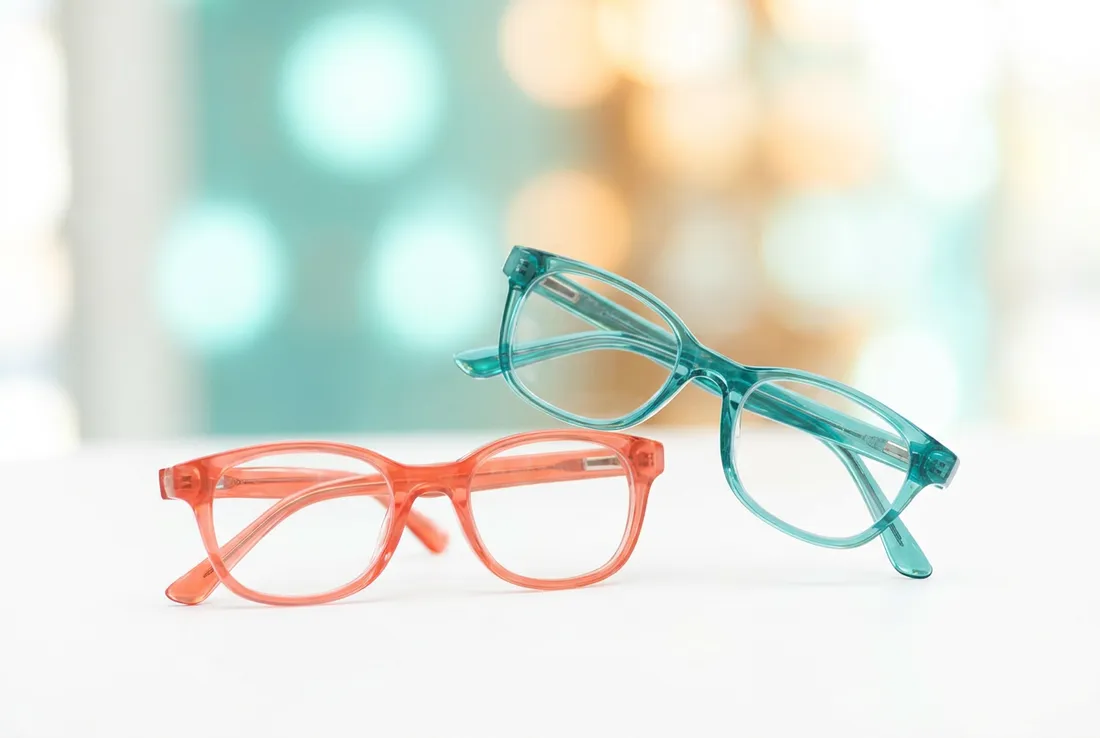
And if glasses are the outcome, our optical carries frames made for kids — sized for small faces, flexible enough to survive a playground, in colors kids actually want to wear. A child who likes their glasses wears their glasses, and that is half the treatment.
When to call us sooner
A couple of things should skip the waiting-and-watching phase entirely: an eye turn that appears suddenly or becomes constant, a white or unusual glow in the pupil in photos, an eye injury, or a child complaining of double vision. Call us at (828) 456-8361 promptly for any of those — same-day if it is an injury or a sudden change.
Booking your child’s exam
If the patterns above sound like your child, you can schedule online anytime, or call (828) 456-8361 and ask for a pediatric appointment. Most of our patients are neighbors — we will not rush, and we will tell you exactly what we found, in plain English.
The Blue Ridge gives kids a lot to look at. We would love to make sure they actually see it.