20-20-20: the rule that fixes most computer-vision complaints.
Every twenty minutes, look at something twenty feet away for twenty seconds. It is free, it works, and it beats most of the things people spend money on.
Dr. Weronika Przepiora, O.D.
·March 25, 2026·4 min read
Most adult patients who come in saying their eyes are killing them by 3 p.m. do not need a prescription change. They need to stop staring at a screen six inches from their face for nine consecutive hours. The 20-20-20 rule is the smallest possible intervention that works, and we coach almost every working adult through it.
The rule is simple. Every twenty minutes, look at something at least twenty feet away for at least twenty seconds. That is the whole prescription. The reason it works is a little more interesting.
Your eyes did not evolve for monitors
For most of human history, distance vision was the default. We tracked moving prey, scanned a horizon, looked for weather coming off a ridge. Near work — sewing, reading, fine craftsmanship — was the exception, and even those tasks involved variable distances and natural light. The eye muscles that control focus and convergence got built for that life.
A screen breaks the pattern in three ways at once. It is the same fixed distance for hours. It is held in dim ambient light against a glowing background that makes the pupil work strangely. And — this is the big one — it captures attention so completely that the involuntary blink reflex slows down.
A fixed distance, dim ambient light, and a tractor-beam screen — the three conditions that quietly halve your blink rate.
What happens when you stop blinking
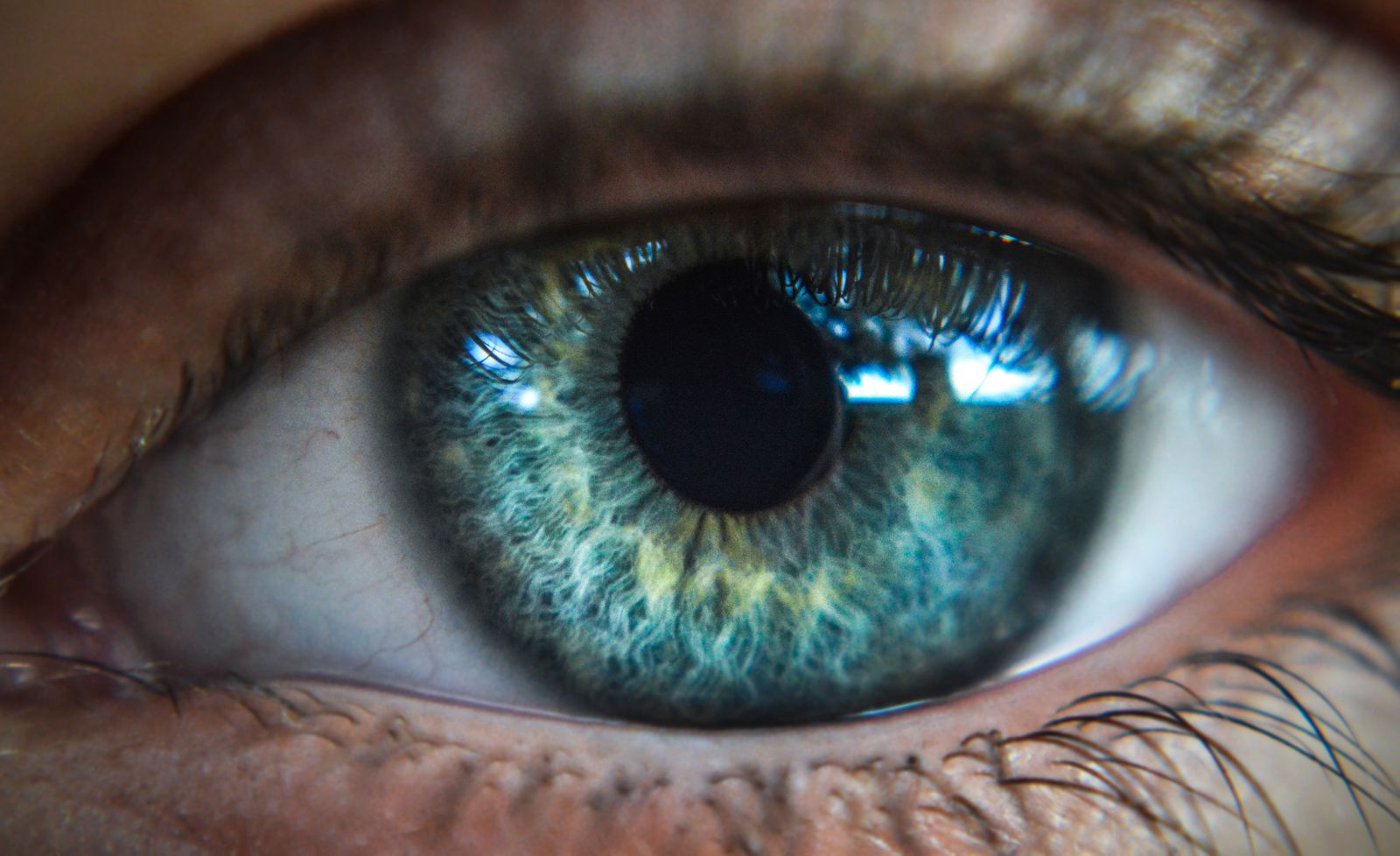
Studies have measured blink rates while reading printed paper versus while reading the same content on a screen. The printed page averages around fifteen blinks a minute. The screen drops to five to seven. That is a more-than-fifty-percent reduction.
Each blink resurfaces the tear film. Less blinking means more evaporation, drier corneal surface, blurry intermittent vision, and — usually — that gritty, end-of-day sandy feeling. Add a wood-stove-dry Waynesville winter (we have a whole post on that) and you have most of what people call "computer eye strain."
Why the rule works
The twenty-foot distance is the magic number because at roughly that range, the eye's focusing muscle — the ciliary body — fully relaxes. Anything closer and that muscle is still working a little; anything farther and it is no closer to relaxing. Twenty feet is, conveniently, far enough for both eyes to read the rule.
The twenty seconds matters too. Shorter and the relaxation does not stick. Longer is fine, but unnecessary. Looking out a window at the parking lot, the mountain ridge, or the print on a wall calendar across the room — anything that resets the focus distance — does the work.
Other small fixes that actually help
If you do 20-20-20 well and still have symptoms, here is what we move to in order. None of these are expensive.
Monitor distance. The screen should be an arm's length from your face, not closer. If the only way you can read it is to lean in, your prescription likely needs an update — make an appointment.
Monitor height. Top of the screen at or just below eye level. A laptop on a desk forces you to look down, which is fine, but a second monitor at eye level is better for long sessions.
Ambient light. Match room brightness to screen brightness. A bright screen in a dark room is the worst case. Bias toward warm, slightly dim room lighting.
Glare control. An anti-reflective coating on glasses (Crizal is our default) cuts the glare bouncing off the screen and off the inside of the lens.
Computer-distance glasses. For patients in their forties and fifties, a dedicated pair tuned to monitor distance is often more comfortable than progressives all day.
Twenty feet is the magic distance — and around here, the view past twenty feet is usually worth pausing for.
And what about blue-light glasses?
We get asked this every week. The honest answer: the evidence that filtering blue light from screens prevents eye strain or retinal damage is weak. The evidence that blue light shifts circadian rhythms and disrupts sleep is solid. So we tell patients: if you work late and have trouble falling asleep, blue-light glasses may help your sleep. They will not fix mid-afternoon strain. That is what 20-20-20 is for.
If you have tried the rule for a couple of weeks and your eyes are still tired, painful, or your vision is blurring intermittently, come in. Eye strain that does not respond to the basics is usually a prescription issue, a dry-eye problem, or, occasionally, a binocular vision dysfunction we can diagnose and treat.
Booking an exam
If your eyes feel worse than they should at the end of a workday, this is a good reason to come in. Schedule online anytime, or call us at (828) 456-8361. The fix is often surprisingly small — and the difference, surprisingly large.
About the author
Dr. Weronika Przepiora, O.D.
Dr. Przepiora earned her Biochemistry degree at the University of Florida — with minors in Disabilities in Society and Spanish — before completing her O.D. at the Southern College of Optometry in Memphis. She finished her residency in Primary Care and Ocular Disease at the WJB Dorn VA Medical Center. A Sarasota native fluent in Polish, Spanish, and English, she leads specialty contact lens fitting at HFEC.